Our Man in South Korea I
10 April 2012
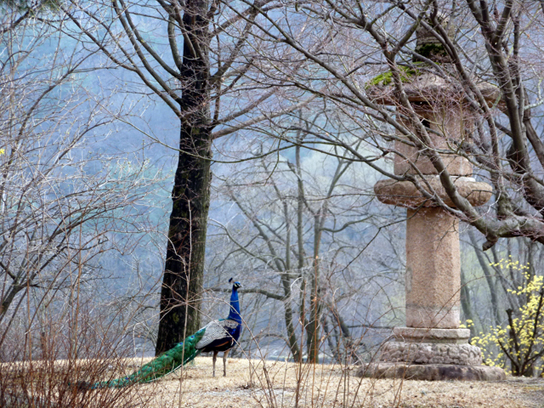
Steve has travelled from Japan to South Korea where he has been invited to lecture at Seoul National University:
'I’ve arrived in South Korea for the last leg of my trip. A new country and experiences ahead for me, but I’m lucky to have had insight from Mr Lee and his lovely family and friends who hosted me for a day. We visited some important cultural sites including the city fortress, palaces, and the contemporary Hee Won Garden which is home to South Korean cultural artefacts placed in the garden setting [above]. It was interesting to learn in more detail how the timeline of Korean art and architecture influenced both Chinese and Japanese landscape design. This exchange of ideas migrates across space and time, adapting to local influences; social, political and geographical.'
Our Man in Japan V
7 April 2012
Steve's visit to Japan is drawing to a close, and here he reflects on the 'imaging' of the landscape and garden. The nature of the Studio's work means this is a continuing line of enquiry for us:
'While I’m having fun photographing the gardens here, I’m also giving myself time and space to sit and absorb the places I’m visiting. It’s giving me opportunity to reflect on how, perhaps more than any other subject, the garden can never really be captured in an image. Because gardens are designed to be moved through, or revered through their maintenance and care, they exist not only in their four dimensions, but also in our bodies and our minds. The cultural appreciation of nature and ‘nature ordered’ can result in very personal responses. The memory of these can remain in our camera and in our mind. However, the two images are not the same. The anticipation and event of the flower opening or the leaf falling is both an image and an experience; particularly the Japanese experience of gardens which can be one of anticipation, excitement and awe. Even if a garden is photographed from the particular angle it was designed to be viewed from, it is still deactivated in a way that denies our multi-compositional viewpoint and sensual understanding of the garden. The garden and the image of the garden are not unrelated, but bring to body and mind a different involvement with the space. Travel allows one to absorb the landscape and its resultant culture in a way that looking at the image can never do. But I do believe that the image can enable one to remember, re-imagine and reflect on that experience, though.'
Our Man in Japan IV
3 April 2012
Steve has visited one of the quintessential Japanese temple gardens:
'I have witnessed Shisen-do. It’s perhaps one of my personal favourite Japanese gardens for its style, scale and sensitivity. Almost hidden from the approach to the garden, the entrance courtyard is restrained; arched-over with blue bamboo and interplanted with glossy leaved camellia. The temple, named after the portraits of 36 poets housed there, originated from the work of Ishikawa Jozan (1583 - 1672), a scholar of garden design, the arts, tea and philosophy.
The temple and gardens are set within the natural landscape which forms both backdrop and counterpoint to the exquisitely manicured azaleas. The gently sloping topography directs both your ‘stroll’ and the view. The gardens exude a quiet, contemplative calm. The combination of materials (both planting and built elements), and also the spatial configuration of the garden, transport you to the wider landscape. At the same time they initiate an intimate connection with the much smaller scale and detail of the garden. This high level of fine horticultural practice and enduring, philosophical design-thinking enables you to at once perceive the garden as the world, and the world within the garden.'